Discover how AION LIO efficiently integrates existing IO-Link sensors into smart city applications, thereby revolutionizing digital infrastructure.
If you want to apply AION LIO to smart city applications, you should shift your focus from traditional factory automation to decentralized infrastructure, utility systems, and municipal applications.
Smart City Applications with AION LIO
The AION LIO makes it possible to integrate existing IO-Link sensors into modern smart city and infrastructure projects without additional data cabling. By combining IO-Link and LoRaWAN®, measurement data can be transmitted over long distances in an energy-efficient and cost-effective manner.
Typical smart city applications include:
- Level monitoring of waste containers and recycling collection points
- Level monitoring of stormwater retention basins and waterways
- Monitoring of pumping stations and water treatment plants
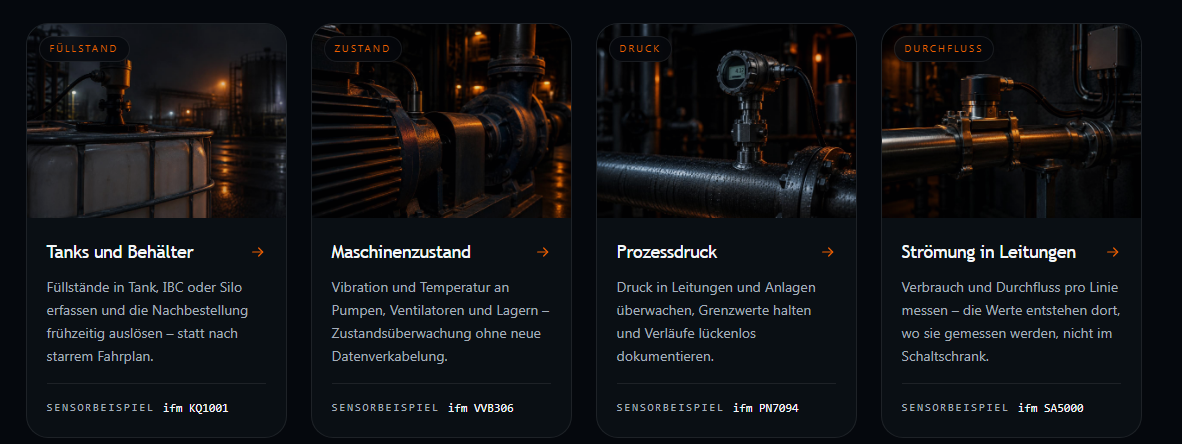
- Measurement of pressure and flow rates in water and district heating networks
- Condition monitoring of ventilation, HVAC, and building systems
- Monitoring of decentralized energy generation systems
- Monitoring of technical systems in public buildings
- Digitization of infrastructure without civil engineering work for data cables
Understanding LoRaWAN® and LPWAN
What is LoRaWAN®?
LoRaWAN® is an energy-efficient wireless network for IoT sensors. It enables the wireless transmission of measurement data over several kilometers and is particularly well-suited for smart cities, industry, building automation, and infrastructure monitoring.
LPWAN at a Glance
LPWAN (Low Power Wide Area Network) refers to wireless technologies for long-range, energy-efficient IoT applications.
Key Differences
LoRaWAN®
- Open standard
- Private or public networks possible
- Long ranges
- Low operating costs
mioty®
- Highly resistant to radio interference
- High scalability for large sensor networks
- Particularly suitable for densely populated sensor environments
NB-IoT
- Mobile network-based
- Good building penetration
- Requires a cellular network and SIM technology
LTE-M
- Mobile network-based
- Higher data rates than LoRaWAN® and NB-IoT
- Suitable for mobile applications and tracking
Why LoRaWAN® for Smart Cities?
LoRaWAN® is particularly well-suited for smart city projects because the technology combines long range, low power consumption, and low operating costs.
With AION LIO, existing IO-Link sensors can be connected directly to a LoRaWAN® network. This transforms a locally available measurement point into a central data source for municipal control centers, energy providers, or smart city platforms.
Benefits for Cities and Infrastructure Operators
- Use of existing IO-Link sensors
- No additional data cabling required
- Quick retrofitting of existing systems
- Centralized data collection via LoRaWAN®
- Easy integration into smart city platforms
- Reduction in installation and maintenance costs
- Scalable digitization of infrastructure projects
That’s right—the compatibility section is a key selling point of the AION LIO and should definitely be included as a separate section in the blog.
Compatibility with thousands of IO-Link
sensors
AION LIO operates based on the open IO-Link standard and enables the wireless integration of a wide variety of existing sensors into LoRaWAN® networks. This allows existing measurement points to be digitized without having to replace sensors or modify the existing automation structure.
For example, AION LIO supports numerous sensors from leading manufacturers such as ifm, Balluff, Baumer, SICK, Siemens, Festo, Pepperl+Fuchs, Turck, Beckhoff, Endress+Hauser, OMRON, and Phoenix Contact.
Typical Smart City Applications
Thanks to its wide range of supported sensors, AION LIO is suitable not only for Industry 4.0 projects but also for smart city and infrastructure applications:
- Level monitoring of waste containers
- Level monitoring of retention basins and bodies of water
- Pressure monitoring in water and district heating networks
- Humidity and climate monitoring in buildings
- Flow measurement in utility infrastructure
- Condition monitoring of pumping stations
- Temperature monitoring in utility rooms and facilities
This allows existing IO-Link sensors to be integrated directly into LoRaWAN® networks without additional data cabling and made available for use in smart city platforms, control centers, or cloud applications.
What LoRaWAN® Can Do—and What It Can’t
LoRaWAN® was developed for the energy-efficient transmission of sensor data over long distances. The technology is ideally suited for monitoring applications in which measured values are recorded and transmitted at regular intervals. However, LoRaWAN® is not designed for real-time control or continuous data streams.
Ideal for
- Long ranges
Reliable data transmission over several kilometers, even in hard-to-reach areas. - Many Sensors in a Network
Hundreds or even thousands of sensors can use the same infrastructure. - Monitoring applications
Perfect for level, pressure, temperature, humidity, flow, or condition monitoring. - Retrofit projects
Existing systems can be digitized without having to install new data cables.
Not suitable for
- Real-time control
Applications with response times in the millisecond range still belong at the PLC or control level. - Streaming large amounts of data
LoRaWAN® is designed for measured values, not for audio, video, or continuous data streams. - Safety-critical controls
Functions related to personal or plant safety remain within the existing automation system.
Conclusion
AION LIO makes optimal use of LoRaWAN®’s strengths: Existing IO-Link sensors transmit their process data wirelessly to IoT platforms, cloud applications, or network servers. The existing automation system remains unchanged, while valuable measurement data becomes digitally available in a simple and cost-effective manner. AION LIO: Wireless IO-Link Sensors via LoRaWAN® | Sentinum