The Things Conference 2026 in Amsterdam showcased innovative IoT solutions, including the AION LIO Bridge, and featured discussions on cutting-edge technologies such as LoRaWAN.
The Things Conference 2026 in Amsterdam was once again one of the most important gathering places for the global LoRaWAN® and Industrial IoT community. Together with customers, partners, and technology providers, we were able to discuss new use cases, present innovative solutions, and gain valuable insights into the future of connected industrial devices.
AION LIO: Introducing the New IO-Link to LoRaWAN® Bridge
A particular highlight was the official unveiling of our new AION LIO, the high-performance IO-Link to LoRaWAN® bridge.
With AION LIO, existing IO-Link sensors and devices can be quickly and easily integrated into LoRaWAN® networks. Companies benefit from wireless connectivity for their IO-Link infrastructure without having to install complex cabling or additional gateways at the machine level.
As a result, AION LIO opens up new possibilities for:
- Condition monitoring
- Machine and process data
- Predictive maintenance
- Smart factory applications
- Retrofit projects in existing facilities
Further information: AION LIO – IO-Link to LoRaWAN® Bridge https://io-link-lorawan-bridge.com/
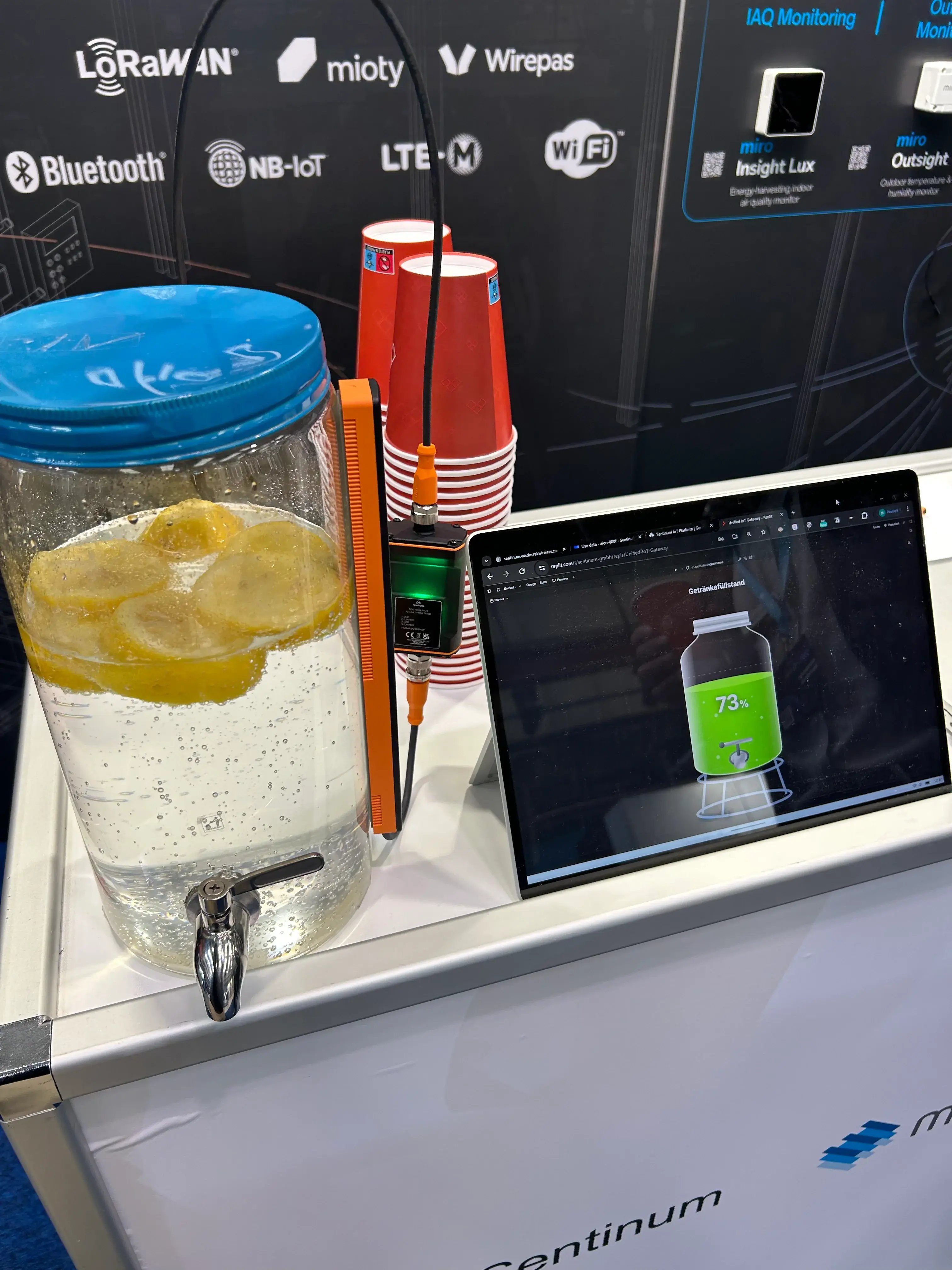
Live Demonstrations: EOS Radar and EOS420
In addition to the product launch, we presented our proven solutions for wireless level and fill monitoring.
EOS Radar Level Sensor
Our battery-powered EOS Radar level sensor impressively demonstrated how silos, tanks, containers, or bulk materials can be monitored reliably and with minimal maintenance. Thanks to radar technology and LoRaWAN® connectivity, EOS is particularly well-suited for applications that require easy installation and long battery life.
Learn more about the product: https://sentinum.de/de/eos-radar
EOS420 for Level Probes and 4–20 mA Sensors
With the EOS420, we demonstrated the wireless connection of existing level measurement probes and industrial 4–20 mA sensors. This allows existing measurement points to be easily digitized and integrated into modern IoT platforms without having to replace existing sensor technology.
More about the product: https://sentinum.de/de/eos-420
Panel Discussion: LoRaWAN®, mioty®, or Cellular Networks?
Another highlight was our participation in a panel discussion moderated by Stefanie Twisselmann, Chief Product & Strategy Officer at Deutsche Telekom IoT.
The central question was:
Which connectivity option is the right choice: LoRaWAN®, mioty®, or cellular?
Together with Annalena Zottmann from Diehl Metering and Martin Lesund from Nordic Semiconductor, we discussed the opportunities and challenges of the different technologies as well as their applications in modern IoT products.
The discussion focused on:
- Power consumption and battery life
- Range and network coverage
- Scalability of large sensor networks
- Data rates and real-time capability
- Costs and operational concepts
- Future-Proofing of IoT Solutions
The most important insight: There is no one-size-fits-all wireless technology for every use case. Optimal connectivity always depends on the specific requirements of the application in question.
“See More, Wire Less”
Together with Alex Raimondi from Miromico AG, we also had the opportunity to present our talk titled “See More, Wire Less.”
In it, we demonstrated how the established IO-Link ecosystem can be integrated with modern LoRaWAN® connectivity and what new possibilities this opens up for industrial applications.
The new AION LIO took center stage and impressively demonstrated how machine and sensor data can be captured wirelessly, transmitted, and integrated into secure industrial IoT ecosystems.

How the IO-Link to LoRaWAN® Integration Works with AION LIO
AION LIO connects the industrial IO-Link world with modern LoRaWAN® networks and enables the wireless transmission of sensor data to local or cloud-based applications. You can find more information here.
The system architecture is intentionally simple: An IO-Link sensor is connected directly to the AION LIO. The adapter captures the sensor data, converts it into LoRaWAN® telegrams, and transmits the information wirelessly to a LoRaWAN® gateway.
Advantages of the architecture:
- Direct connection of existing IO-Link sensors
- Wireless data transmission via LoRaWAN®
- Use of local or cloud-based IoT infrastructures
- Easy integration into existing Industrial IoT platforms
This allows IO-Link devices to be quickly digitized even in distributed plants, retrofit projects, or hard-to-reach areas, without the need for additional cabling over long distances.
Flexible operating models for industrial applications
A key advantage of AION LIO is its flexibility in data processing. Companies can choose between different operating models and tailor the integration to their specific infrastructure.
Option A: On-Premises
The sensor data is processed via a local network server and made available within the existing corporate infrastructure. This option is particularly suitable for applications with high requirements for data protection and local data storage.
Option B: Cloud Connection
Alternatively, the data can be processed via a cloud network server and integrated into cloud-based applications. This allows sensor data to be analyzed and monitored regardless of location.
Option C: Network Server Directly on the Gateway
For compact installations, the network server can be operated directly on the LoRaWAN® gateway. This eliminates the need for an external network server and allows the data to be used locally immediately.
This flexibility enables the use of AION LIO in both traditional industrial facilities and modern cloud and edge computing environments.
IODD Parsing: Interpreting Sensor Data Exactly Where It’s Needed
Another key focus of the presentation was flexible IODD parsing. IODD (IO Device Description) describes the structure and meaning of the data transmitted by the sensor and enables the automatic interpretation of raw data.
AION LIO offers several options for evaluating sensor data:
- Interpretation via a payload decoder
- Interpretation via the Sentinum IOWA Cloud Service
- Interpretation directly on the hardware
- Interpretation via a local on-premises parsing server
This allows companies to decide for themselves at which stage the conversion of raw data into meaningful measurement values takes place. This significantly simplifies the integration of a wide variety of IO-Link sensors and reduces the implementation effort in IoT projects.
The key benefits of AION LIO at a glance
- Integration of existing IO-Link sensors into LoRaWAN® networks
- Wireless transmission of sensor and machine data
- Flexible cloud, edge, and on-premises architectures
- Support for IODD-based data interpretation
- Easy digitization of existing systems and retrofit projects
- Quick implementation without additional cabling
- Scalable Industrial IoT solutions for smart factory applications